 Smoking Vaping Alcohol Regulations
Japan's smoking rules are strict and hyper-local. Know where you can light up outdoors, avoid fines, and find designated zones before you land.
Japan has some of the most precisely enforced smoking regulations in Asia, and they differ block by block. The national law covers indoor spaces, but outdoor rules are set by individual municipalities, which means a street corner that is fine to smoke on in one ward can carry a 2,000-yen fine in the next. Getting this wrong is easy and expensive.
- Indoor restaurants
- Smoke-free since April 2020
- Hotel rooms
- Smoking rooms available
- Outdoor
- Only in designated areas
- Walking while smoking
- Banned in many municipalities
- Vaping (nicotine)
- Legal but restricted like cigarettes
- E-cigarettes (IQOS)
- Widely available at combini
The 2020 Indoor Ban
The Revised Health Promotion Law (健康増進法), fully enacted in April 2020, made virtually all indoor public spaces smoke-free: restaurants, bars, cafes, offices, hospitals, schools, and public transport. No exceptions for size. Establishments that were operating before April 2020 and are owner-operated with no hired staff can apply for a legacy exemption, but this applies to a shrinking number of small izakaya. In practice, assume any indoor venue is smoke-free unless you see a posted smoking room sign.
Hotels are the main carve-out. Many business hotels and ryokan still maintain designated smoking rooms (喫煙室, kitsuenshitsu) or smoking floors. These are sealed, separately ventilated rooms: you cannot smoke in a standard guest room. Book carefully: cancellation policies vary, and non-smoking rooms are the overwhelming majority.
Outdoors: It Depends Entirely on the Ward
This is where tourists most often go wrong. Japan has no national outdoor smoking law. Instead, each municipality or ward sets its own rules, enforced independently.
Tokyo is the most fragmented example:
- Chiyoda ward (home to the Imperial Palace, Akihabara) banned all outdoor smoking except in designated zones back in 2002, one of the first in Japan.
- Shinjuku, Shibuya, Minato (Roppongi, Harajuku) all prohibit smoking on main streets and near train stations.
- Asakusa (Taito ward) has designated zones near Senso-ji, but smoking on surrounding streets is banned.
Outside Tokyo, Kyoto bans outdoor smoking in Gion, around Fushimi Inari, and in most heavily touristed streets. Osaka enforces bans near Dotonbori and Namba station areas. Nara prohibits smoking throughout the deer park and Todai-ji approach.
The rule of thumb: anywhere near a train station, shrine, temple, or tourist street, assume smoking is banned outdoors unless you see a posted 喫煙所 (smoking area) sign.
Walk-and-Smoke: Specifically Illegal
Separate from zone restrictions, walking while smoking (歩きタバコ, aruki tabako) is banned by ordinance in most major municipalities regardless of whether the area itself is a smoking zone. Even if you are standing in a permitted outdoor zone, taking a few steps with a lit cigarette can technically constitute a violation. This rule targets pedestrian safety and litter, not just air quality.
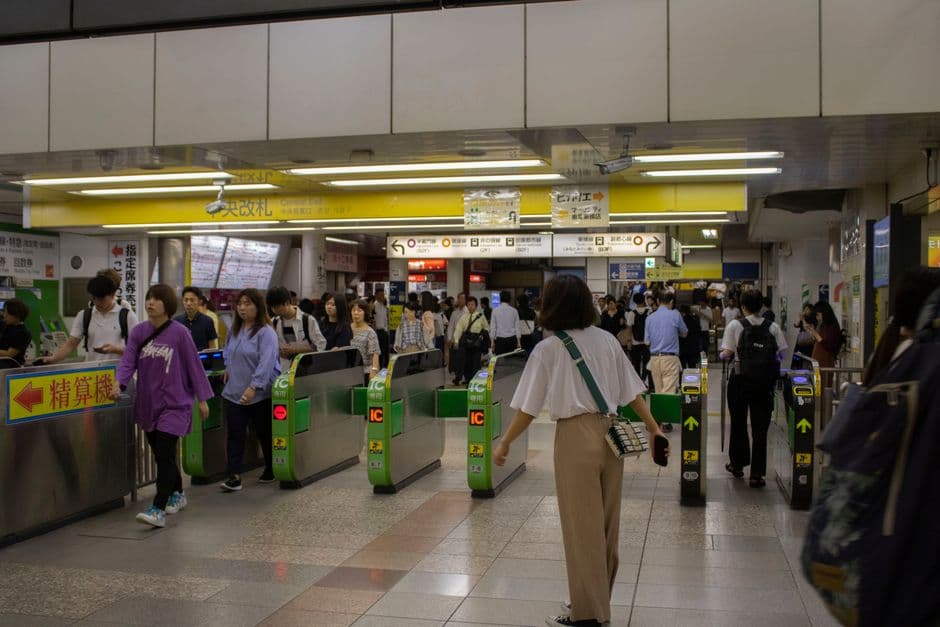
Enforcement is real. Chiyoda and Shibuya both deploy uniformed and plainclothes inspectors, particularly near JR and metro exits. Fines are issued on the spot.
Fine for Outdoor Smoking in Wrong Zone
Tokyo wards like Chiyoda and Shibuya actively enforce outdoor smoking bans. Fines are typically 1,000-2,000 yen. Undercover inspectors operate near popular tourist areas.
Finding a Legal Smoking Spot
Designated outdoor smoking areas (喫煙所) exist at most large train stations, inside some convenience stores (7-Eleven and FamilyMart sometimes have enclosed smoking booths), and near office buildings. The Tabaco Map (タバコマップ) app aggregates legal smoking spots by GPS location and is genuinely useful in dense urban areas. Google Maps searches for "喫煙所 + neighborhood name" also return accurate results.
Many smoking areas are small, enclosed, and crowded during lunch hours. Ventilation quality varies.
Vaping and Heated Tobacco (IQOS, glo, PloomX)
Nicotine vaping (liquid e-cigarettes) is legal in Japan but falls under the same restrictions as cigarettes for indoor and outdoor use. Nicotine e-liquid is technically a pharmaceutical product and cannot be sold over the counter: many tourists bring a supply from home.
Heated tobacco devices (IQOS, glo, PloomX) are a different matter entirely. Japan is one of the world's largest markets for these products. They are sold openly at combini and dedicated tobacco shops. Legally, they are treated the same as cigarettes: banned in smoke-free indoor spaces, and subject to the same outdoor zone rules. In practice, some restaurants that pre-date the 2020 law allow heated tobacco because the aerosol is lighter: ask before assuming.
The bottom line: smoke only where you see a 喫煙所 sign, never while walking, and never indoors unless you are inside a posted smoking room. Japan's rules are strict but consistently signposted: ignorance is the only real risk.

 Smoking
 Smoking