 Sacred Historical Site Etiquette
Exact rules for visiting Buddhist temples in South Korea, how to bow, where you can't photograph, and conduct rules that get you banned.
South Korea has roughly 900 active Buddhist temples, and in every one, the monks are still working. These are not heritage museums. Seokguram Grotto, Haeinsa, Tongdosa: all active places of worship where liturgy happens at dawn, noon, and dusk. Your visit is tolerated, not owed.
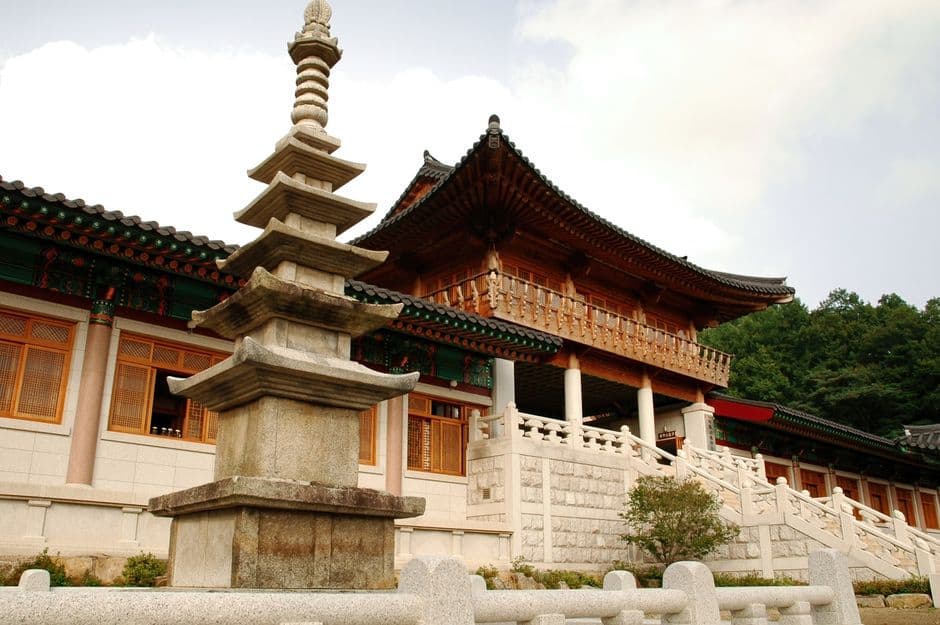
Entering the Grounds
Remove your shoes before stepping onto polished wooden floors or cushioned worship halls (beopjeon). A sign in Korean or a row of shoes at the threshold is your cue. Leave footwear neatly to the side, never piled or blocking the entry.
Dress codes are stricter than most visitors expect:
- Cover knees and shoulders. No tank tops, no shorts. Some larger temples (Jogyesa in central Seoul is the most visited) keep loanable cloth wraps at the gate for ₩1,000 or free.
- No hats inside the main hall. Caps and beanies come off the moment you cross the threshold.
- Silence in the beopjeon. Not library-quiet, genuinely silent. Step lightly, speak only if you must, and keep it to a whisper.
Bowing: the Mechanics
The standard temple bow is the full prostration (108 bae) during formal ceremony, but visitors are expected only to perform a brief standing bow (合掌, hapjang): palms pressed together at chest height, slight forward incline of the head. Do this when:
- Entering or leaving the main hall
- Passing in front of the main Buddha image
- Greeting a monk
The 108-count prostration is a devotional act, do not mimic it as a tourist gesture unless you are participating in a templestay program (공식 템플스테이), where a guide will walk you through the posture. Mimicking it carelessly is considered disrespectful rather than charming.
Photography Rules
Default assumption: no photography inside halls. Even when no sign is posted, the rule holds in virtually every active beopjeon. The exceptions:
- Outdoor courtyards, stone pagodas, and gates, almost universally permitted
- Some temples with strong tourist programs (Bulguksa near Gyeongju, Beomeosa near Busan) post explicit "photography allowed" notices inside certain side halls
What gets visitors removed:
- Flash photography near painted wood, silk thangkas, or lacquered sutras, the light genuinely damages centuries-old pigment
- Photographing monks without permission, especially during chanting
- Selfies in front of the main Buddha image, treated as mockery, not admiration
- Turning your back to the main altar for a photo
When in doubt: put the camera away, walk through, then photograph the exterior on your way out.
During Active Ceremonies
If you arrive during morning service (usually 04:00–06:00) or evening service (18:00–19:00), you may observe from the back of the hall, but you may not walk through the congregation. Stand still or leave quietly. Never cross between the monks and the altar.
Templestay programs (formally managed by the Korean Buddhist Jogye Order at templestay.com) are the structured way to participate rather than observe. Programs at Magoksa, Woljeongsa, and Golgulsa include a monk-led orientation that covers all of the above in practice, not theory.
The Jogye Order's one rule
The Jogye Order of Korean Buddhism (조계종) publishes a visitor conduct card in English at the entrance to most affiliated temples. Pick one up at the gate, it lists exactly which halls permit photography and notes any special rules for that specific site.
Leaving
Bow once more facing the main hall as you exit the courtyard. Do not leave donations inside the hall unless a monk invites you to, donation boxes are outside, near the gate or in the courtyard.
Loud conversation resuming the moment you clear the threshold is common and fine. The rules apply inside; the mountain path back to the bus stop is yours.
 Sacred Historical
 Sacred Historical