 Sacred Historical Site Etiquette
Bow three times, hold incense correctly, never point your finger. A practical guide to behaving respectfully in Taiwan's Buddhist and Taoist temples.
Three sticks of incense, both hands cupped around them, facing the main deity: that is the default greeting in virtually every Taiwanese temple, whether the shrine honours Mazu, Guanyin, or the Earth God. Get that sequence right and locals will treat you as a respectful guest rather than a confused tourist.
The Incense Protocol
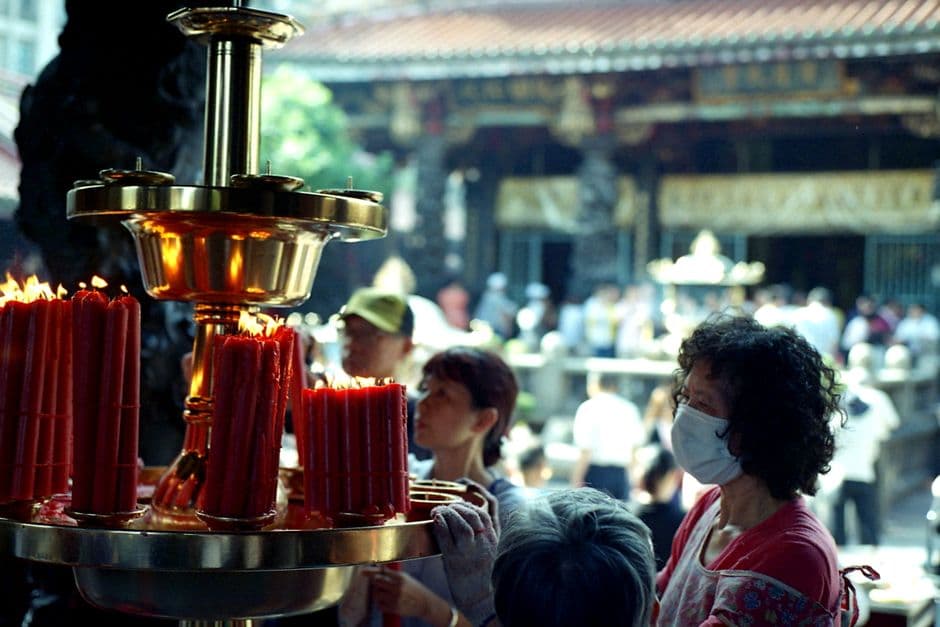
Most large temples, including Longshan Temple in Wanhua (Taipei) and Xingtian Temple in Zhongshan, sell incense at the entrance for NT$30–50 per bundle. The standard offering is three sticks (representing heaven, earth, and humanity in Taoist practice) or one stick per altar in some Buddhist temples.
Lighting and holding:
- Light all sticks at once from the flame provided, then fan or wave them out, never blow. Blowing is considered disrespectful, as your breath is seen as impure.
- Hold the incense upright with both hands, thumbs on top, at chest or forehead height.
- Face the main altar first, bow three times with eyes closed while making your silent petition.
- Work clockwise through the subsidiary altars, repeating the bow.
- Insert sticks into the large outdoor censer upright and centred, not at an angle.
Bowing: Count to Three
A single nod is a greeting. A proper temple bow is a deliberate, 90-degree forward bend from the waist, held for a count of one. Repeat three times per altar. At some Buddhist temples you will see people perform full prostrations (kneeling and touching forehead to the floor), this is reserved for serious practitioners and is not expected of visitors.
Dress Code and Physical Conduct
Taiwan is considerably more relaxed than Southeast Asian temples, but a few rules still apply:
- Cover your shoulders and knees inside the main hall. A light scarf or sarong in your bag solves every situation.
- Remove hats before entering the main hall. Sunglasses off as well.
- Do not sit on the altar steps or lean against the offering tables.
- Never point a single finger at a deity image, use an open hand if you need to gesture.
- Photography is generally permitted in courtyards and at exterior shrines, but always check for posted signs. Flash photography directly at statue faces is considered offensive at most sites.
Navigating the Space
Enter and exit through the side doors, not the central gate, which is reserved for deities and officiating priests. This rule is explicitly posted at Longshan Temple and Baoan Temple in Datong District.
The central corridor between the entrance and the main altar is called the shendao (神道), the divine path. Avoid walking straight up it; approach the altar from the side.
When a ceremony or prayer recitation (early morning at 6 AM and evening around 7 PM at most temples) is in progress, step aside quietly and wait. Do not cross in front of the altar during active worship.
Offerings: What to Bring
If you want to bring an offering, fruit is universally appropriate, oranges, bananas, pineapple. Pears (lí, 梨) are traditionally avoided for Mazu and some ancestor shrines because the word sounds like "separation."
Xingtian Temple exception
Xingtian Temple in Taipei banned incense burning inside the main hall in 2014 to reduce air pollution. Offerings here are made with flowers and fruit only, incense is burned in a designated outdoor area. Do not bring your own sticks inside.
Key Things That Will Get You Noticed (Badly)
- Wearing all white or all black to an active ceremony (these colours are associated with mourning).
- Touching the deity statues, even to wipe dust or reposition a fallen flower.
- Walking behind the main altar without permission.
- Speaking loudly or laughing during active prayer.
Taiwan's temples are living places of worship visited daily by thousands of believers, not museum exhibits. Matching even a fraction of the care locals bring to them earns genuine warmth in return.
 Sacred Historical
 Sacred Historical