 Language Communication
Decode Japanese train signs confidently using colours, numbers, and a handful of kanji: no language skills required.
Japanese train networks are among the most punctual and extensive on earth, and, at first glance, among the most intimidating for a traveller who cannot read kanji. The good news: the system was built to be navigable by non-readers. You just need to know which visual cues to trust.
The colour-and-number system does most of the work
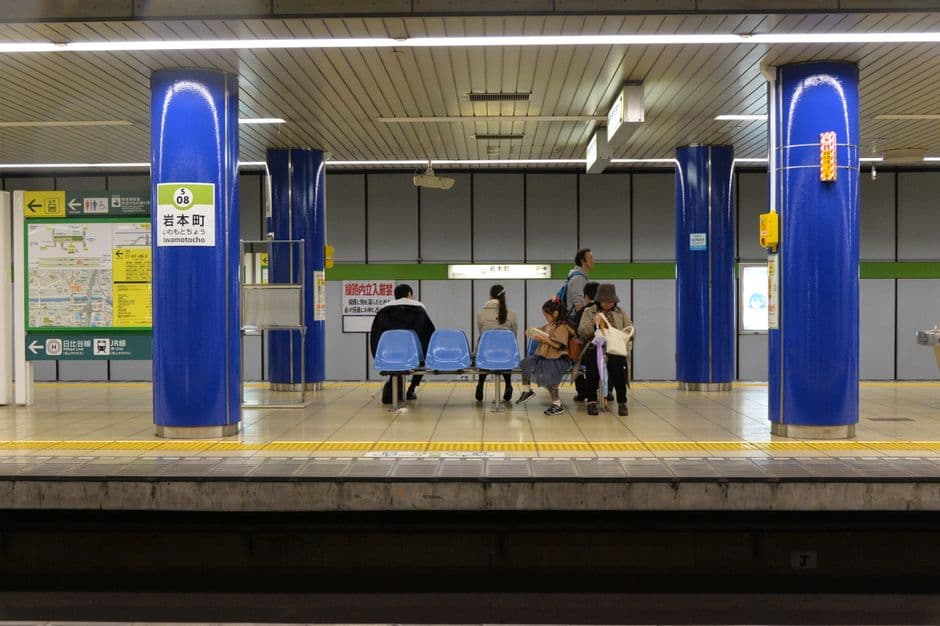
Every major urban line in Japan has a letter code and a station number. On the Tokyo Metro, Hibiya Line stations are marked H-01, H-02, and so on. The Osaka Municipal Subway uses the same logic. These codes appear on every platform pillar, every train-door marker, and every in-carriage display. You never need to read a single character: find your destination station's code on the map before you board, then watch the numbers count up or down.
Line colours are equally reliable. The JR Yamanote Line is always lime green. The Marunouchi Line is always red. Even when a sign is entirely in Japanese, a coloured stripe alongside it tells you which line you are on.
The six kanji that unlock almost every sign
You do not need to memorise hundreds of characters. Six kanji cover the vast majority of navigational signs:
- 出口 (deguchi): Exit. The character 出 looks like something leaving a box. You will see it everywhere.
- 入口 (iriguchi): Entrance. 入 is the mirror concept.
- 乗換 (norikae): Transfer/connecting line. Appears at every interchange station, always with an arrow.
- 行き (yuki): Bound for. On platform screens, the destination name precedes 行き: "新宿行き" = bound for Shinjuku.
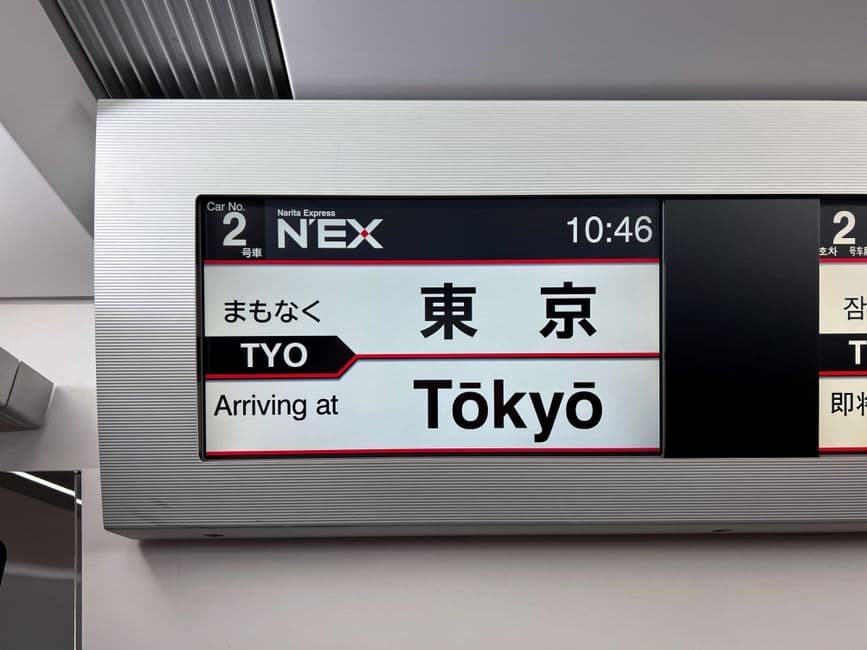
- 次は (tsugi wa): Next stop. The automated announcement and the in-carriage display both use this phrase before the upcoming station name.
- 禁止 (kinshi): Prohibited. Follows an icon showing whatever you must not do. No food, no phone calls, no bicycles.
Spend ten minutes with these before your first train journey and you will read the essential content of any station sign.
Platform screen doors show both scripts
Every LED board above platform screen doors displays the station name in kanji, hiragana, romaji, and English, in that rotating order. Wait three seconds and the English version appears. No need to decipher anything.
Navigating interchanges and exits
Large interchange stations such as Shinjuku, Osaka, and Nagoya have dozens of exits, each numbered or lettered. Exit A1, B3, South Exit (南口), Central Exit (中央口): these labels appear in romaji or English alongside the Japanese. When a hotel or attraction gives you an exit number, photograph it and match it to the signs overhead: the coloured banners guide you corridor by corridor.
Numbered exits are your best friend. "Meet at Shinjuku Station South Exit" is a sentence that exists entirely in English on the signage. You will not misread it.
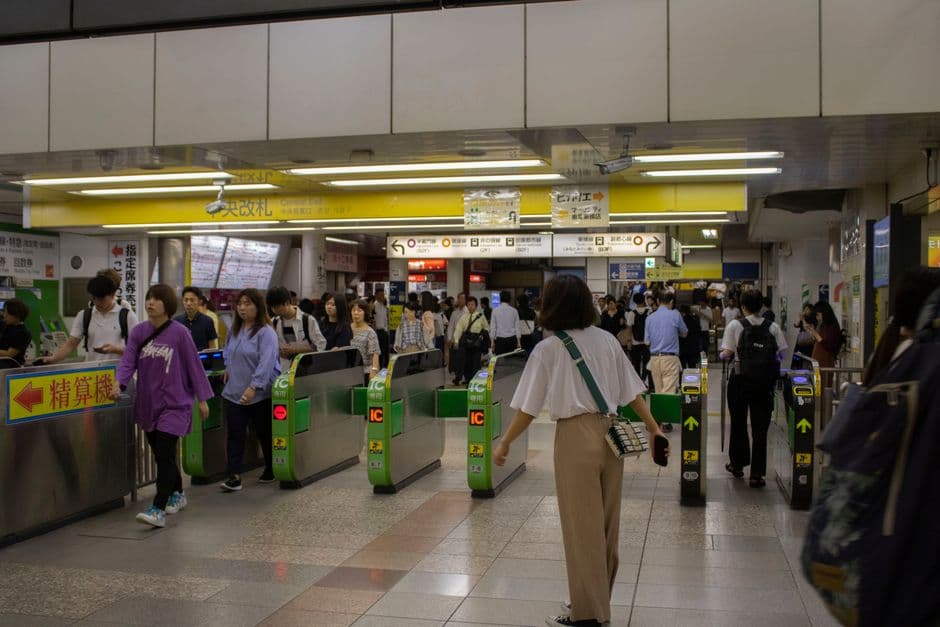
For transfers between operators, say, from JR to Tokyo Metro, follow the 乗換 symbol. It is always paired with the destination line's colour band, so even if you cannot read the line name in kanji, the colour confirms you are heading the right way.
What to do when signs fail you
In rare cases (older rural stations, some private lines outside major cities) English signage thins out. Three reliable fallbacks:
- Google Maps offline mode. Download the region before you leave your hotel. The app shows your train in real time, names the next stop in English, and alerts you when to get off.
- Ask station staff. Every staffed station has a みどりの窓口 (Midori no Madoguchi, green ticket office) or an information window. Staff are trained to assist tourists; show them your destination written in English or on a map.
- The IC card tap-in, tap-out system means you cannot accidentally ride past your stop and pay nothing: the gate will flag the overshoot. The financial penalty is minor and refundable at the exit gate machine.
Japan's train network rewards methodical preparation over linguistic fluency. Memorise the six kanji, trust the numbers, and you will navigate Tokyo or Osaka as confidently as any local.
Train-sign searches answered
You do not need Japanese fluency to navigate most major stations. Learn the English destination, line colour, platform number and transfer symbol first; use the station map and departure board to confirm the train before boarding.