 Accessibility Dietary Nuances
Taiwan has thousands of Buddhist vegetarian restaurants, but 'vegetarian' here often means no garlic either. Here's how to navigate it.
Taiwan has more vegetarian restaurants per capita than almost any country in Asia, roughly 6,000 registered 素食 (sùshí) establishments nationwide. The reason is religious: a large Buddhist and Taoist population follows a diet that excludes not just meat and fish, but also the "five pungent roots", garlic, onions, leeks, shallots, and chives. Understanding this distinction is the key to eating well as a plant-based traveller here.
Показать на Mandarin Chinese:
The Two Tiers of Vegetarian in Taiwan
Pure vegetarian (純素 / chún sù): No animal products whatsoever, no meat, no seafood, no eggs, no dairy, and no five pungent roots. This is the standard Buddhist temple diet and is what most dedicated sùshí restaurants serve by default.
Egg-and-dairy vegetarian (蛋奶素 / dàn nǎi sù): Allows eggs and dairy but still no meat or fish. Fewer restaurants specialise in this, but it appears as a menu option in many mainstream sùshí spots.
If you are vegan but eat garlic and onions, you need to ask specifically: "我可以吃蔥蒜" (Wǒ kěyǐ chī cōng suàn), "I can eat onions and garlic." Many kitchens will accommodate you.
How to Identify a Vegetarian Restaurant
Look for the 菜根香 (Cài Gēn Xiāng) logo, a green leaf symbol displayed on the storefront, which is Taiwan's official vegetarian certification mark. Most sùshí restaurants also display 素食 prominently in red or green on their signage.
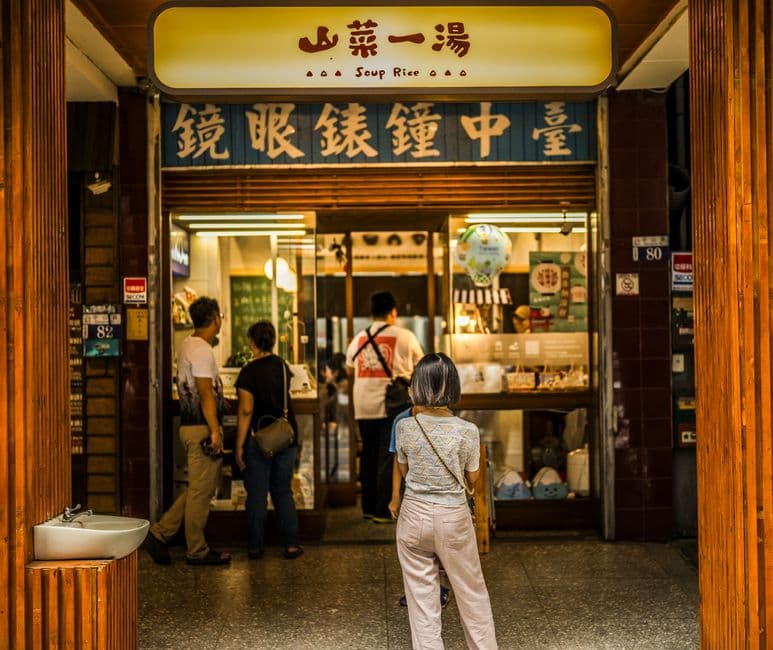
Chains to know:
- 蓮心素食 (Lián Xīn Sùshí), buffet-style, around NT$120–180 per person, branches across Taipei and Taichung. You fill a tray with hot dishes by weight.
- 素食自助餐 (sùshí zìzhùcān), generic term for the ubiquitous buffet format. These are everywhere near temples and universities. Expect to pay NT$80–150 for a heaped plate.
- Loving Hut (愛家), international vegan chain with 30-plus Taiwan branches; English menus available; dishes are clearly labelled pure vegan.
Night markets are trickier. Most stalls cook with lard or shared oil. Look for stalls with the green leaf sign, or head to Shilin Night Market's dedicated sùshí aisle near the indoor food court.
Temple Canteens: The Hidden Gem
Major Buddhist temples often run canteens open to the public during lunch hours (typically 11:00–13:00). These serve pure Buddhist vegetarian food at cost or by donation.
- Fo Guang Shan (佛光山), Kaohsiung, the largest Buddhist monastery in Taiwan runs a full restaurant on-site; NT$100–200 per person.
- Longshan Temple (龍山寺), Taipei, the nearby alley (Guangzhou Street) has a cluster of pure sùshí lunch counters catering to temple visitors.
- Dharma Drum Mountain (法鼓山), New Taipei, day visitors can eat in the retreat canteen; pure vegan, no garlic, donations accepted.
Practical Phrases
What to Watch For
Oyster sauce and fish sauce appear in ostensibly vegetarian dishes at non-specialist restaurants, particularly in stir-fries. Always confirm at non-sùshí venues.
Mock meat is everywhere in Taiwanese sùshí cooking, textured wheat gluten (麵筋 / miànjīn) and soy-based "pork" and "shrimp" are kitchen staples. If you prefer whole-food cooking over processed substitutes, specify "不要素肉" (bù yào sù ròu), "no mock meat."
Convenience stores (7-Eleven, FamilyMart, Hi-Life) stock a rotating selection of labelled vegan onigiri and bento boxes, most clearly marked 純素 on the packaging, reliable for a quick, cheap meal anywhere in the country.
Taiwan's sùshí infrastructure is genuinely one of the best in the world for plant-based travellers. Once you know the signs and a handful of phrases, eating here without meat, eggs, or dairy is not a workaround, it is the mainstream option.
 Accessibility
 Accessibility