 Flights Route Metrics Jet Lag
Taiwan runs on UTC+8 year-round, no DST. Here's how to beat jet lag fast with daytime recovery tactics and a proven sleep schedule.
Taiwan operates on China Standard Time (CST), UTC+8, year-round. There is no daylight saving time, clocks never change. That simplicity is one less thing to miscalculate when you land at Taiwan Taoyuan International Airport (TPE) disoriented and hungry at the wrong time of day.
How Far Is Taiwan From Your Body Clock?
The gap between your home time zone and UTC+8 determines how hard jet lag hits you and in which direction.
- From Western Europe (UTC+1/UTC+2 summer): 6–7 hours ahead. You arrive in Taiwan with your body convinced it is early morning when Taipei is humming at midday. Eastward travel is the harder direction, harder to fall asleep on arrival night, earlier wake-ups.
- From the US East Coast (UTC-5/UTC-4 summer): 12–13 hours. This near-inversion is deceptive. Most travellers find it manageable because the extreme gap can actually flip your schedule clean rather than fragment it.
- From the US West Coast (UTC-8/UTC-7 summer): 15–16 hours ahead, or equivalently 8–9 hours behind. Flying west from Los Angeles to Taipei, you effectively lose an afternoon.
- From Australia East (UTC+10/+11): only 2–3 hours behind Taiwan. Jet lag is minimal; a single early night usually resolves it.
The key variable is direction of travel. Flying east (Europe or Americas to Taiwan) compresses your circadian day; flying west (Australia, East Asia) extends it. Eastward travellers take roughly 1 day per hour of time difference to fully adapt, expect 6 to 7 days from Paris, up to 12 from New York if you do nothing proactive.
Daytime Recovery: The Taipei Advantage
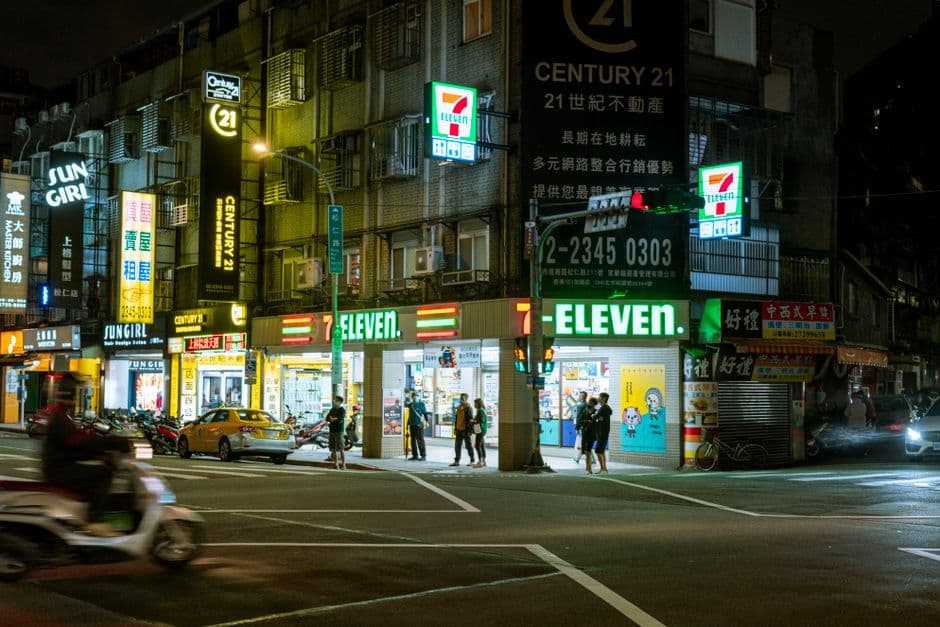
Taiwan's street culture works in your favour. Night markets open until 01:00, rooftop cafés in Da'an District run until late, and 7-Eleven and FamilyMart (both ubiquitous across Taipei, Taichung, and Kaohsiung) sell caffeine, electrolytes, and warm food around the clock. You are never stuck waiting for something to open.
The daytime recovery strategy:
- Stay awake until 22:00 local on your first night. This is the single highest-leverage action. Even two hours of afternoon sleep at a hotel in Zhongzheng or Xinyi districts will destroy your first night's sleep and add two extra days of grogginess.
- Eat on Taiwan meal times immediately. Breakfast at Yong He Soy Milk (永和豆漿) in Zhonghe from 06:00, lunch at any local noodle shop by 12:00. Food timing anchors your gut clock, which is independent of your brain clock.
- Get sunlight before 10:00. Walk the Tamsui Riverside path or Daan Forest Park. Morning light suppresses melatonin and advances your body clock forward, exactly what eastward travellers need.
- Avoid heavy alcohol for the first 48 hours. Taiwan Beer is cheap and excellent; it also fragments sleep architecture and blunts light-based clock resetting.
Paris → Taipei
Pergeseran tidur sebelum perjalanan
- Ke timur lebih sulit: hari Anda dipersingkat.
- Beberapa hari sebelumnya, tidur dan bangun sekitar 1 jam lebih awal setiap hari.
- Saat tiba, dapatkan cahaya pagi yang terang dan hindari cahaya di malam hari.
- Tidur siang singkat sebelum pukul 15.00 saja; pergi keluar pada hari kedatangan.
Practical Sleep Tactics for the First Three Nights
Night 1: Take 0.5 mg of melatonin (available over the counter at Watson's pharmacies throughout Taiwan) at 21:00 local time. Not 3 mg, the low dose signals the clock without causing grogginess the next morning. Blackout curtains in most Taiwanese business hotels are excellent; use them.
Night 2–3: Move melatonin to 22:00. Resist the temptation to nap past 15:00. A 20-minute rest before that window is fine; anything longer and you will be wide awake at 03:00 staring at your hotel ceiling in Ximending.
Light blocking on the flight: If you fly into TPE overnight and land in the morning, wear blue-light blocking glasses for the last two hours of the flight. This preserves your melatonin level so that when you land in daylight, you control when you expose yourself to the light signal rather than getting it involuntarily through airport windows.
Temperature drop: Taiwan hotels default to aggressive air conditioning, use it. Core body temperature must drop by roughly 1°C to initiate sleep. Setting your room to 19–20°C accelerates sleep onset even when your body clock is misaligned.
One Number to Remember
UTC+8, fixed. When your friend in London texts you at 09:00, it is 16:00 in Taipei in winter, 15:00 in summer. No DST adjustments, no "spring forward" confusion mid-trip. Build that constant into your schedule app before you board.
- Time zone
- UTC+8 (CST) year-round
- Daylight saving
- None
- Adaptation rate
- ~1 day per hour eastward
- Melatonin dose
- 0.5 mg at 21:00 local
- Pharmacy chain
- Watson's (nationwide)
Taiwan rewards early risers, morning dim sum, uncrowded temples, cool mountain air on Yangmingshan. Nail your first two nights and you will be on local time before your second full day ends.
 Flights