 Public Restrooms Local Sanitation Rules
Squat or seated? Taiwan has both. Know which to expect, how to use them correctly, and the one rule that catches every visitor off guard.
Taiwan's most important toilet rule has nothing to do with squat vs. seated: do not flush toilet paper. In the vast majority of public restrooms, and many older private ones, the pipes cannot handle paper. A small bin sits beside every toilet for used tissue. Ignore it and you risk a blocked pipe and a very awkward conversation with a cleaner.
With that established, here is everything else you need to navigate Taiwanese restrooms with confidence.
Two Types, Very Different Experiences
Squat Toilets (蹲式馬桶)
Squat toilets remain common in older buildings, night markets, temple compounds, rural bus stations, and highway rest stops. They are white porcelain troughs set flush into the floor, oriented so you face the hooded end (the side with the flush mechanism). The flush button or lever is usually at the top of the hood, on the wall, or on a pull-chain above.
Using one correctly:
- Face the hood, not away from it. This is the single most common mistake.
- Feet go on the textured grip pads on either side of the basin.
- Keep your weight on the balls of your feet, heels raised slightly, this is easier in flat shoes than heels.
- Lower your clothing to mid-thigh before squatting, not to your ankles.
- Flush, then place used paper in the bin beside you (not the basin, unless a sign explicitly says otherwise).
Squat toilets at MRT stations, Eslite bookstores, SOGO department stores, and most chain restaurants have largely been replaced by seated models, but never assume.
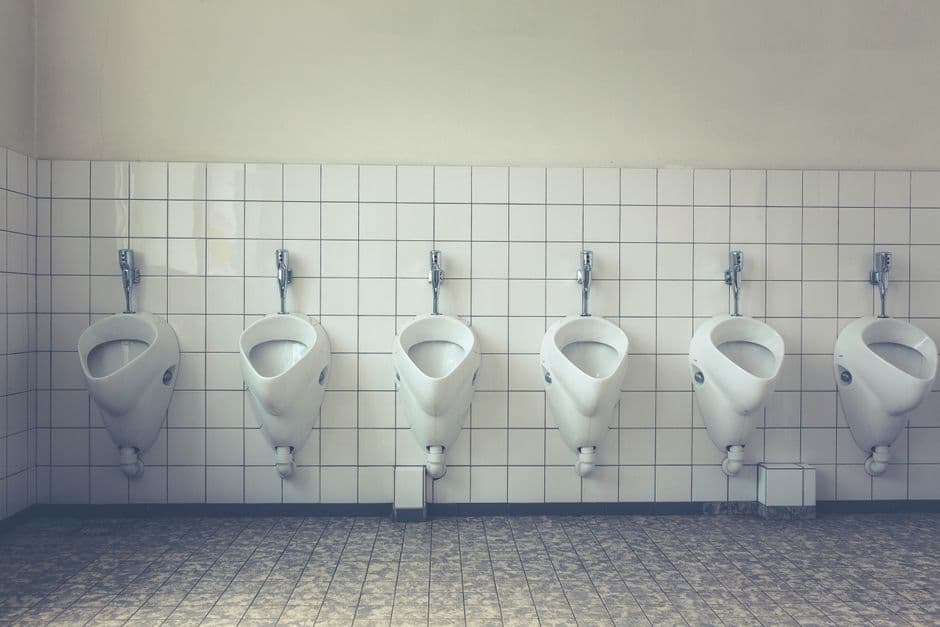
Seated Toilets (坐式馬桶)
Modern Taiwan leans hard toward seated Western-style toilets, and in Taipei especially, Toto and Panasonic washlets with heated seats and bidet functions are standard in hotels, convenience stores (7-Eleven, FamilyMart), shopping malls, and newer apartment blocks. The control panel, sometimes a wall-mounted remote, sometimes a side-arm panel, offers rear wash, front wash, water pressure, and seat temperature. Press the spray button once, not repeatedly; the nozzle self-cleans before and after use.
Washlet first-timers
The default water pressure on Taiwanese washlets tends to be strong. Hit the pressure-down button (usually a minus icon) before committing to a spray.
Where to Find Clean Restrooms
High reliability: Any 7-Eleven, FamilyMart, Hi-Life, or OK Mart. Convenience store restrooms are free, generally clean, and open 24 hours. MRT stations in Taipei, Kaohsiung, and Taichung maintain consistently well-kept facilities with both squat and seated options.
Variable quality: Night market stalls, older temples, rural train stations. Carry a small pack of tissues, dispensers run out. Portable hand sanitiser is worth having because soap is sometimes absent.
Gender markings: Look for 男 (men) and 女 (women). Many public venues also offer a 親子廁所 (parent-child room) and a 無障礙廁所 (accessible/universal room), the latter is often the largest, cleanest, and most likely to have a seated toilet if the main block is squat-only.
Key Etiquette Points
- Bin, not bowl. Used paper goes in the bin every time, in every restroom, unless a green sticker on the bowl specifically says 衛生紙可沖 ("toilet paper flushable"). These stickers are rare but do exist in some newer Taipei buildings.
- Queue calmly. Lines at popular night markets can be long. Cutting is not acceptable.
- Knock before entering. Occupied indicators (a red dot or a visible latch) are not universal. A single knock is standard.
- Leave it dry. Many Taiwanese users wipe down any water splashed on the seat or floor as a courtesy. Paper towels or a small cloth are usually available for this.
- No smoking is enforced by the Tobacco Hazards Prevention Act (菸害防制法) in all indoor restrooms. The fine is NT$10,000 (around USD 310).
Taiwan's restrooms are cleaner on average than many visitors expect. The bin rule is the only genuine adjustment required, treat it as automatic from your first stop at the airport, and the rest follows naturally.
 Public Restrooms
 Public Restrooms