 Unusual Rules
Tokyo stands left, Osaka stands right: Japan's unwritten escalator etiquette can embarrass you on day one. Here's exactly what to do and why.
- Tokyo
- Stand left, walk right
- Osaka
- Stand right, walk left
- Rule strength
- Unwritten but strictly observed
Step onto the wrong side of a Japanese escalator and you will know immediately. No one will shout. No one will shove. But the ripple of silent disapproval from commuters behind you, and the physical bottleneck you create, makes the mistake impossible to miss. Japan's escalator convention is one of the most location-specific unwritten rules in the country, and it splits cleanly along a single city boundary.
Tokyo and the Kanto Standard: Stand Left
In Tokyo, Yokohama, and most of the Kanto region, standing passengers keep to the left. The right lane is kept open for people in a hurry who walk up or down. This mirrors left-hand traffic in Japan more broadly and aligns with conventions in London and Hong Kong.
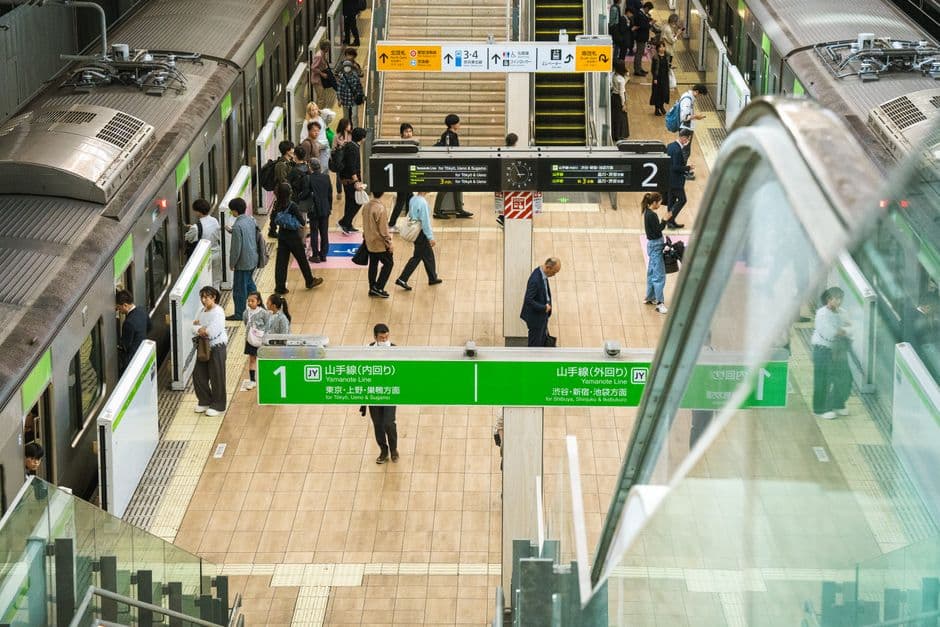
The rule holds everywhere from the deep platforms of the Yamanote Line to the sky-bridges of Shinjuku Station, the world's busiest station by passenger count. Arriving at peak hour (07:30–09:30 on weekdays) and getting this wrong on a packed platform escalator is a real problem, not a mild inconvenience.
Osaka and the Kansai Exception: Stand Right
Cross into Osaka, Kyoto, or Kobe and the convention flips. Standing passengers move to the right, leaving the left lane free for walkers. The origin story most often cited is the 1970 Osaka World Expo: local authorities asked visitors to stand right to speed up crowd flow, and the habit stuck.
Osaka commuters take this seriously. On the escalators of Umeda Station or inside the OCAT bus terminal, the lanes are as disciplined as anywhere in Tokyo, just mirrored.
The Kyoto Trap
Kyoto follows Kansai convention (stand right), but it receives enormous numbers of Tokyo-based domestic tourists. Do not let the tourist crowds mislead you: default to local convention, which is always the right lane for standing.
Why the Rules Differ (and Why Both Work)
The short answer is history: Japan's railway networks developed city-by-city, with Kanto and Kansai evolving separate customs before any national standard existed. There is no law governing escalator etiquette anywhere in Japan. What enforces compliance is pure social pressure, applied through silence and precise spatial choreography.
In practice, both systems move people efficiently precisely because they are consistent within their own region. The breakdown happens only when outsiders, foreign tourists or domestic travellers crossing between regions, disrupt the pattern.
Practical Rules for Travellers
- Check your city before you check in. Tokyo, Yokohama, Nagoya, Sapporo, Fukuoka = stand left. Osaka, Kyoto, Kobe = stand right.
- When in doubt, watch the first two people ahead of you. Locals will self-sort within seconds of stepping on.
- Nagoya is genuinely ambiguous. The city made a concerted push in the 2010s to abolish the walking lane entirely (stand two-abreast), partly inspired by London's failed 2016 experiment. Compliance is inconsistent: observe before committing.
- Walking lane etiquette: if you do walk, move at a steady pace. Stopping mid-escalator to check a map in the walking lane is worse than standing on the wrong side.
- Station-specific exceptions exist. Some heavily congested stations, including several on the Tokyo Metro Ginza Line, have posted signs requesting all passengers stand still two-abreast due to escalator length and safety. Follow the posted signage over the local convention in these cases.
The Broader Trend: Standing-Only Campaigns
Since 2021, the Japan Elevator Association has pushed a nationwide campaign asking passengers not to walk on escalators at all, citing safety data on stumbles and falls. Several major stations in Tokyo and Osaka now post bilingual signs making this request. The standing-only idea has not yet displaced the walking-lane convention at most stations, but the signs are worth reading: they signal where enforcement is tightest.
The Fastest Read
Arriving at a new station? Glance at the escalator for three seconds before stepping on. The standing queue forms instantly and tells you everything you need to know about which side the locals have already claimed.
Understanding this one rule removes a common source of friction on your first day in Japan. It costs nothing and signals immediately that you are paying attention, which, in a country where public space is managed through collective awareness rather than explicit instruction, counts for more than you might expect.