 Food Culture Local Dining Etiquette
Decode Korean restaurant menus with confidence: spice icons, hangul basics, pricing norms, and menu board layouts explained for first-time visitors.
Most Korean restaurants display no English at all. That is not hostility, it is normal, even in Seoul's tourist-heavy Myeongdong district. The good news: Korean menus follow a rigid, learnable structure, and a handful of recurring pictograms do almost all the work.
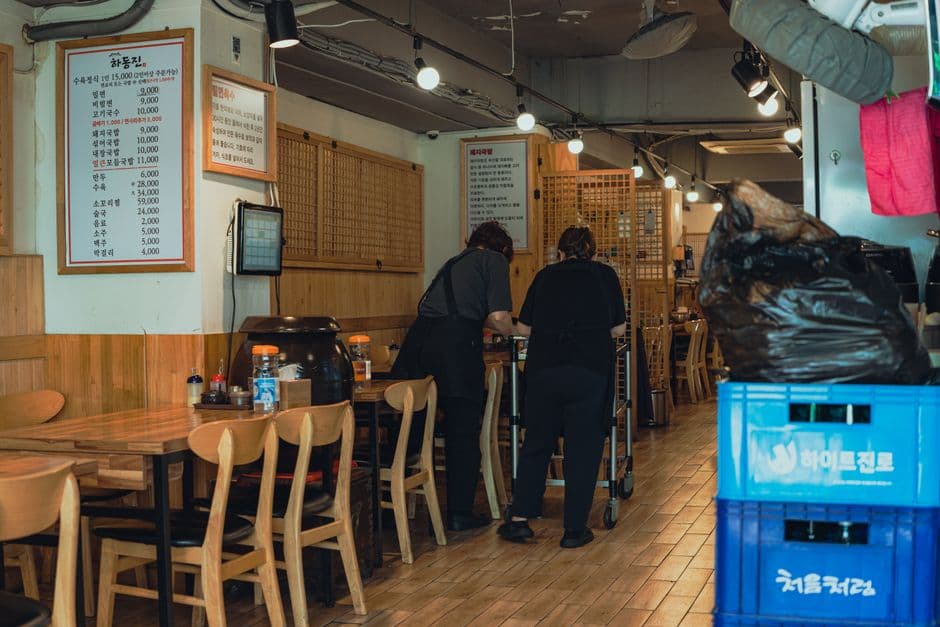
The anatomy of a Korean menu board
Walk into any pojangmacha (street tent stall), bunsik (snack restaurant), or mid-range sikdang (general restaurant) and you will find the menu either laminated on the table, chalked on a wall board, or printed on an A-frame outside. The layout is nearly universal:
- Category header (e.g. 찌개류 jjigae-ryu = stew category, 면류 myeon-ryu = noodle category)
- Dish name in hangul, sometimes with a romanisation or photo below
- Price in Korean won (₩), always written as a plain number, ₩9,000 means nine thousand won, roughly USD 6–7 at mid-2026 rates
Prices at local restaurants almost never include service charge; tax (VAT, 10 pct) is already folded into the displayed price by law under Korea's Value Added Tax Act (부가가치세법). What you see is what you pay.
Pictogram system: spice and allergen icons
The most valuable visual shorthand on Korean menus is the spice flame icon (🌶 or a red pepper drawing). Restaurants rate dishes on a 1-to-3 scale:
- 고추 1개 (one pepper): mild heat, usually safe for most palates
- 고추 2개 (two peppers): medium, think kimchi jjigae at a standard restaurant
- 고추 3개 (three peppers): genuinely hot, dishes like 불닭볶음면 (fire noodles) or certain 닭갈비 (spicy stir-fried chicken) preparations
Beyond spice, look for small allergen icons mandated since 2023 under Korea's Food Labeling and Advertising Act (식품표시광고법). Chain restaurants (Lotteria, Gimbap Cheonguk, Bon Juk) must display the 22 major allergens. Independent restaurants are not legally required to list them on menus, though they must provide information on request.
A V or green leaf symbol marks vegetarian-friendly dishes, still rare outside Seoul's Itaewon and Hongdae areas, but increasingly present after Korea's plant-based food market grew 37 pct between 2021 and 2024.
The six hangul words that unlock most menus
You do not need fluency. Memorise these six words and you can parse the majority of menu boards:
| Hangul | Romanisation | Meaning |
|---|---|---|
| 밥 | bap | rice (often means a rice-based meal) |
| 국/탕 | guk / tang | soup / broth-based dish |
| 찌개 | jjigae | thick stew (served bubbling at the table) |
| 구이 | gui | grilled (meat, fish) |
| 볶음 | bokkeum | stir-fried |
| 세트 | se-teu | set meal (comes with banchan sides) |
When you see 세트 next to a price, you are getting the full spread: main dish plus the rotating small plates (banchan) the kitchen decides that day. Ordering à la carte is possible but unusual in traditional restaurants.
Photo menus, QR codes, and kiosks
Since 2022, kiosk ordering (키오스크) has become standard at fast-casual chains and increasingly at independent restaurants. The kiosk interface switches to English with one tap, look for the flag icon in the top-right corner. At sit-down restaurants without kiosks, a QR code on the table links to a Coupang Eats or proprietary digital menu, often with automatic language detection based on your browser locale.
If neither option exists, photograph the menu and use Naver Lens (the camera icon inside the Naver app), it translates hangul in real time and, unlike Google Lens, pulls Korean restaurant database entries to show dish photos alongside the translation.
Pricing norms to know
A bowl of 김치찌개 (kimchi stew) at a local restaurant costs ₩7,000–9,000. A 삼겹살 (pork belly) dinner per person runs ₩15,000–20,000 before drinks. Prices in tourist corridors like Insadong or Bukchon Hanok Village run 20–30 pct higher than the same dish two streets off the main drag. Menus rarely change mid-season, but 오늘의 메뉴 ("today's menu" board) signals a daily special that may not be listed elsewhere, always worth pointing at and asking "이거요?" ("this one?").